|
3rd Sunday Easter |
|
|
Dear Preachers:
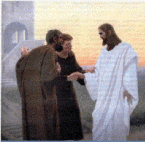
While we might love the New Testament stories, especially those where Jesus heals or offers forgiveness to needy “outsiders,” there are some that we could label “classics.” Today’s gospel might be called a classic tale. The resurrected Jesus appears to two disheartened disciples, confused and perplexed by the tragic, heartbreaking events of recent days.
What happened to these disciples back in Jerusalem confused and disappointed them. It made no sense to them. Perhaps there are events in our families, communities, or the world that confuse us as well. How do we explain events that leave us uncertain? We pray, yet our prayers do not seem to be answered. Our hopes for family, health, unity in our church, or peace in the world do not unfold as we hoped. Still, we keep walking, carrying our disappointments and questions with us. In other words, we are confused disciples on our own road to Emmaus. Let us join the two in the gospel story; perhaps what they discover and learn will help us on our own journey.
What is striking in our gospel account is that Jesus comes alongside the two disheartened disciples and, at first, they do not recognize him. He listens to their story, letting them express their disappointment and confusion. Where was their glorious God in the defeat of Jesus? They had hoped he would redeem Israel; instead, Jesus seemed to have let them down. Their dreams were shattered, so they left Jerusalem – the former place of hope – talking about their loss.
Many of us can recognize that walk. We have all had moments when our faith felt uncertain; when prayers seemed futile and unanswered; when hopes for ourselves, our families, the church, or the world did not unfold as we had hoped. Like those two disciples, we keep walking, carrying questions and disappointment with us.
Jesus often meets us where he met the two travelers to Emmaus – in the course of our own travels. He listens to our sadness; we are invited to tell our stories. We do not hold back as we speak out of our own sorrow. How does Jesus help us come to faith when things seem dire? He does for us what he did for the two: he opens the Scriptures to help us see that God is still at work and has not deserted us to suffering and apparent defeat.
Do we expect flashes of light or a thundering voice of God to address our doubts and disenchantment? No – Christ meets us quietly and patiently at surprising moments: in our conversations, daily routines, exchanges with others, and even in our own doubts. At first it may be hard to recognize him in those moments, but later we come to say, “Were not our hearts burning within us?”
When did things change for the two on the road? When they said to Jesus, “Stay with us,” and when they sat at table with him. He broke the bread, and their eyes were opened – not in a miraculous or grand display, but in the familiar gesture of broken and shared bread.
For Luke’s community, and for us, the message is clear. We encounter the risen Christ in Word and Eucharist, in community and hospitality. They asked him, “Stay with us…,” and he did. Notice what happened next after he revealed himself to them. The two disciples did not stay on their path to Emmaus. They returned to Jerusalem, back to the community they had left. They had encountered the risen Lord, and that encounter sent them back – not only to the community, but to the troubled and confused world they had tried to leave.
That might seem surprising. Why not simply go back to their homes, believe in Jesus, and say their prayers?
Instead, faith moved them from discouragement to mission, from isolation to community. Faith does that for us too. Our Emmaus story offers us both reassurance and challenge. Christ walks with us even when we do not recognize him. He speaks to us through Scripture and shared prayer. He reveals himself in the breaking of the bread and then sends us back into the world with renewed hope because of the message we have heard and the bread we have shared. As we are told at the end of our Eucharist: “The Mass has ended; go in peace.” Or “Go and announce the Gospel of the Lord.”
So, the question after Emmaus is not only, “Did they recognize Jesus?” but, “How will they live now that they have?”
The early Christians faced that very question once the excitement of the resurrection encounter settled into daily life. They had to learn how to live their faith in ordinary routines, in challenging circumstances, and sometimes in societies that did not understand them. That is where our second reading speaks to us today.
Let us look briefly at our second reading from the First Letter of St. Peter. He is speaking to early Christians scattered throughout Asia Minor. They were living in a pagan culture, often feeling like outsiders because of their faith. They were trying to live Christian lives in societies that did not share their values. Sound familiar? Peter calls them “sojourners,” or “exiles,” not because they were literally foreigners everywhere, but because their deepest loyalty – their true citizenship – belonged to God.
In many ways their situation mirrors ours, especially as we try to live faithfully in a world with priorities different from our own.
Peter reminds them that they were living between resurrection and fulfillment. Like us in this Easter season, they believed and trusted that the risen Christ was enabling them to live their daily lives in hope. Peter is speaking to believers like us who are trying to be faithful in a complicated world. They had to decide what truly lasts and what fades away. So do we.
The resurrection tells us that love, mercy, faith, and hope – unlike many things in the world – are not perishable. They endure, and their fruits sustain us. “Perishable things” are not only money or property. They include reputation, comfort, control, youth, success, and even our carefully constructed plans. All these might be good, but none can save us or give us lasting peace.
In this Easter season, Peter’s message is both freeing and challenging. We have been saved by something imperishable. Therefore, we are invited to live with lighter hands, deeper trust, and greater compassion. We are called to invest in what lasts: faith, reconciliation, mercy, and service to others. These are treasures that do not fade.
Click here for a link to this Sunday’s readings: https://bible.usccb.org/bible/readings/041926.cfm
QUOTABLE “Hope has two beautiful daughters: their names are anger and courage; anger at the way things are, and courage to see that they do not remain as they are.” – Augustine of Hippo
You were ransomed from your futile conduct —1 Peter 1:18
There is a lot of duality in all three readings today. The First Reading presents Peter as a changed man. The Second Reading addresses Christian communities with their dual challenge to be uprooted from what they were familiar with and face alienation in a society that misunderstood their newfound religious beliefs. Then, in the Gospel, we have two disciples meeting the Risen Christ. This enduring presence of the risen Christ among his disciples then and his disciples now, radically re-creates their lives and our lives. We have been ransomed from our futile conduct. Do you see the duality? We were once one kind of a person but now we are another. Not only do we have all these ancient witnesses, but we also have the actions of God in our lives AND the promise that our souls will not be abandoned to the netherworld. Our life, like Peter, is a transformed one. This past Lenten season, we have been presented many opportunities to choose a life of merciful service to the poor, the disadvantaged, and to care for the suffering natural world. It is as counter-cultural to help the least of these today as it was in Jesus’ time. Our culture screams at us, “Me, me, me.” The “selfies” photo phenomenon grows stronger. Making it on your own is admired while community life is looked upon as weakness. Introspection is in short supply. In this transformational period of Easter time, we should continue to ask ourselves: “Who am I?” “Who is God?” Why am I here?” “What am I to do with my life as a transformed follower of Jesus? As Pope Leo writes in Dilexi Te: Christians too, on a number of occasions, have succumbed to attitudes shaped by secular ideologies or political and economic approaches that lead to gross generalizations and mistaken conclusions. The fact that some dismiss or ridicule charitable works, as if they were an obsession on the part of a few and not the burning heart of the Church’s mission, convinces me of the need to go back and re-read the Gospel, lest we risk replacing it with the wisdom of this world. The poor cannot be neglected if we are to remain within the great current of the Church’s life that has its source in the Gospel and bears fruit in every time and place (15). Be transformed and, together, we can transform the world. Barbara Molinari Quinby, MPS, Director Office of Human Life, Dignity, and Justice Ministries Holy Name of Jesus Cathedral; Raleigh, NC
Mini-reflections on the Sunday scripture readings designed for persons on the run. “Faith Book” is also brief enough to be posted in the Sunday parish bulletins people take home. FROM TODAY’S GOSPEL
They said to him, REFLECTION: Hope is the virtue that enables us to dream big dreams and work to put them into reality. But we often need our hopes nourished, because if what we hope for is important----peace, care for the elderly, an end to the death penalty, a rejuvenated and healed church, good liturgy and preaching in our parish, housing for the elderly, an end to domestic violence, equality of women and gays in our churches and communities, fair treatment for immigrants, and so much more----then we will need encouragement, perseverance, passion, clear thinking and the support of a believing and hoping community. We need the Word of God, the Eucharist and a faith community that shares our dreams and gives us hope. AND SO, WE ASK OURSELVES: · When I am discouraged, who gives me hope? · Who are the people in the world who kindle hope in me and challenge me to persevere in my good works? POSTCARDS TO DEATH-ROW INMATES
“One has to strongly affirm that condemnation to the death penalty is an inhuman measure that humiliates personal dignity, in whatever form it is carried out.” ---Pope Francis
Inmates on death row are the most forgotten people in the prison system. Each week I am posting in this space several inmates’ names and locations. I invite you to write a postcard to one or more of them to let them know that: we have not forgotten them; are praying for them and their families; or whatever personal encouragement you might like to give them. If the inmate responds, you might consider becoming pen pals. Please write to: · Thomas Larry #0233526 (On death row since 4/28/1995) · Darrell Woods #0497100 (5/22/1995) · Timothy Richardson #0492102 (6/1/1995) Central Prison P.O. 247 Phoenix M.D 21131 (While the prison is in Raleigh mail for inmates is processed at this address)
For more information on the Catholic position on the death penalty go to the Catholic Mobilizing Network: http://catholicsmobilizing.org
“First Impressions” is a service to preachers and those wishing to prepare for Sunday worship. It is sponsored by the Dominican Friars. If you would like “First Impressions” sent weekly to a friend, CLICK HERE. If you would like to support this ministry, please send tax deductible contributions to: Fr. Jude Siciliano, OP St. Albert Priory 3150 Vince Hagan Drive Irving, Texas 75062-4736
Make checks payable to: Dominican Friars. Or go to our webpage to make a secure online donation: https://www.PreacherExchange.com/donations.htm
FREE EMAILS: We have two English email lists available: a. A preacher's early reflections on the upcoming Sunday's readings and liturgy, always at least one week ahead of the Liturgical Calendar. “A tool to help Preachers prepare for their next trip to the Ambo.” Available in Spanish & English and authored by Fr. Jude Siciliano, OP. b. Click Here to Sign Up. 2. “VOLUME II”
If you would like to submit a reflection of your own, then Click Here to send it as a “Request to Post” to the Webmaster. Deadline is Monday of each week for the upcoming Sunday.
OUR WEBSITE: https://www.PreacherExchange.com - Where you will find Preachers Exchange, which includes “First Impressions,” and “Volume 2” as well as articles, book reviews, daily homilies and other material pertinent to preaching and Scripture reflection.
FOR INFORMATION OF “ANY KIND” OR TO MAKE A SUGGESTION:
(Always includes the 6 latest reflections with the newest first.)
• |
|